
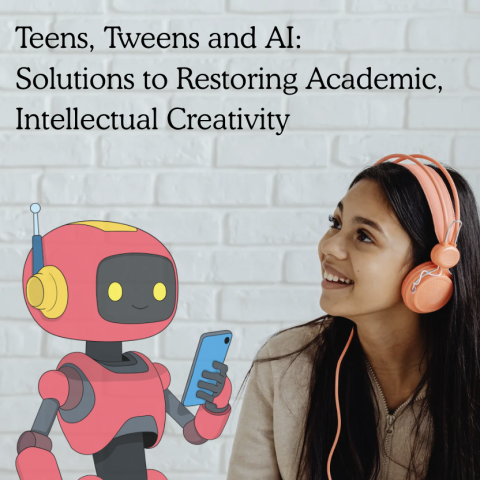
Nowadays, K-12 teachers deal with a demanding and inescapable issue: children are using AI to write all of their papers, leading thought-based assignments and critical thinking exercises to be more difficult to deploy. It is becoming near impossible to be able to encourage children and teenagers to want to utilize their own academic effort, creative ideas, and personal gifts of intelligence. In a culture where speed and productivity have been so heavily emphasized, it makes sense why children want to save time and energy --- or are even simply going to do so by default, habit. There is not a huge incentive to exert their mental capacity on hours of homework when it is not necessary, nor rewarded the same way Chat GPT might produce an A+ paper. However, the less they do use their own time, patience, and mental capacity, the more low the threshold for what is considered high intellectual effort. Writing an essay feels so grueling when they haven't spent years used to writing them. It would be considered a big, special event of a project. Before AI, kids were used to having to write lots of material weekly, and it had to come entirely from their own minds. They were used to it. They were also allowed to be imperfect, unclear, or have errors. Now, children are more inclined to want things to come out clean, the way AI is designed to generate computational thought for a perfect grade.
Maybe there is something we can do at home, or generally in society, to encourage complicated thinking, the ability to withstand a project that takes a little bit longer, something to boost our value on creativity and imperfection. Something to make human-centered thought rewarding instead of energy consuming and "unproductive." We can allow children and teens to generate something that feels very human, and celebrate the work they do with their own hands. Or, limit AI use to only account for 15% of the job, where they fill in the rest --- using it as a tool and not a substitute for any achievement. Overall, the problem is that young people are willing to produce something fast, shallow, and easily gratified because it gives them more time to focus on other things.
What are the other things they are so inclined to focus on?
Schools need to be able to build an incentive for children to do their own work instead of it being done solely with AI --- we want to save their intellectual incentive to be creative in academics. Therefore, maybe the work has to be more interesting to the child. It has to even be fun and stimulating for the child. We could use this as an opportunity to individualize assignments. We can use this as an opportunity to become even more human, by asking children what it is that would make them more interested and inclined to want to do their own research and write their own paper from scratch. What do you want to learn about more than anything right now? How can we connect your schoolwork to that, instead of the basic core curriculum? AI, on the positive side, could be forcing us to find our humanity in a deeper way than ever before --- since it runs the risk of it being taken away.
The grading may also have to change. What if children were not graded on something AI could provide so perfectly, such as regimented, logical adherence to mechanical explanatory papers? AI may begin taking over the realms of tasks that are inherently mechanical. We would pivot our focus to less mechanical activities, or making formerly mechanical activities less mechanical. What if the grade depended on how much unique individualism and out-of-the-box thinking the child displayed? Of course, competence in the subject would be evaluated, but not the main priority; as in, their way of being able to think around a subject became more important than memorization. AI memorizes. AI regurgitates. What can the child learn how to do from our system that would really serve them in self development? Resourcefulness and the ability to use AI, yes. They have this. But in this case of concern for creativity and individualism, and a true, real interest in participating in laborous thought, they would have to be evaluated educationally on the basis of participation in interesting critical thinking --- originality and individualized decisiveness. We would be nurturing the very thing we so deeply fear they will lose.
At home and in therapy, this means working against perfectionism, celebrating identity exploration, and being in tune with the value of making mistakes. This means paying extra special attention to signs of personal, niche interests and trying to find meaning in the hobbies and projects that children select. This means being willing to work outside of the mold of expectations you might have to funnel children through and being open to them presenting a new or abstract perspective on their lives.