
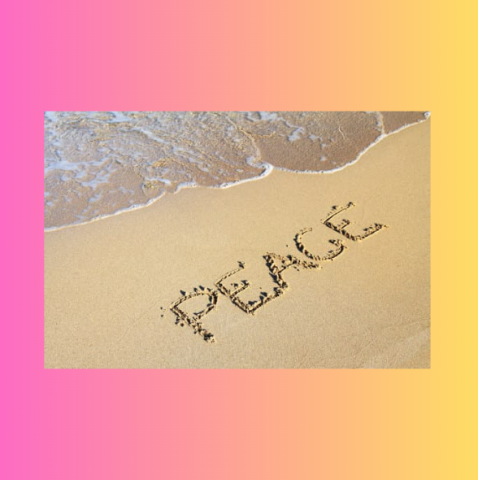
In life, there will always be situations that are messy, unfair, or painful—things we wish we could change, but simply can’t. Whether it’s a difficult relationship, a medical diagnosis, a job loss, or a global crisis, our natural impulse is often to fight against reality. We brace ourselves, plan harder, ruminate longer, or try to fix things beyond our reach. But what if peace doesn't come from controlling the situation to get the outcome we think we need? What is peace comes from doing the exact opposite, and choosing to surrender? Surrender is not about giving up or being passive. It’s about releasing resistance to what we cannot change and focusing our energy where it actually matters: what we can do in the present moment to maximize tranquility and grace.
To surrender means to stop fighting with reality. It’s the internal shift from “This shouldn't be happening” to “This is happening—now how do I move through it with integrity?” Surrender asks us to let go of the illusion that we can—or must—control everything. It teaches us that peace does not come from mastering our external environment, but from aligning ourselves with what is within our power. This is not a message of hopelessness. In fact, surrender creates space for hope—not hope that things will be perfect, but hope that we can find steadiness and resilience regardless of what life brings.
Part of the work of surrender is being honest with ourselves about the limits of our control. Consider the following:
-
You cannot control another person’s behavior, decisions, or emotions.
-
You cannot change the past or prevent every hardship in the future.
-
You cannot force others to understand you or give you the validation you crave.
-
You cannot eliminate every obstacle, mistake, or disappointment.
When we try to control what’s uncontrollable, we become emotionally drained and mentally stuck. We rehearse arguments, obsess over outcomes, and grip tightly to "what should be"—often missing the opportunity to make peace with "what is." The liberating truth is that, while much is outside of our control, much also lies within it. You can choose how you relate to difficult circumstances and how you care for yourself in the midst of them.
You can control:
-
Your mindset – the stories you tell yourself about what’s happening.
-
Your actions – the small, consistent steps you take each day.
-
Your focus – what you give your energy and attention to.
-
Your boundaries – how you protect your peace and values.
-
Your self-talk – whether you meet yourself with criticism or compassion.
Surrender shifts your gaze from what you can't do to what you can do. It doesn’t require everything to be okay. It simply requires you to keep showing up in ways that align with your values, even when things around you aren’t ideal. In Acceptance and Commitment Therapy (ACT), surrender shows up as a core principle called psychological flexibility—the ability to stay grounded in the present and take meaningful action.
ACT teaches us that resisting pain often increases suffering, but accepting pain as part of life allows us to focus on what really matters. Rather than wasting energy trying to change the unchangeable, we can invest in value-driven actions—acts of courage, kindness, creativity, and self-respect. In this framework, surrender is not defeat. It’s a way of reclaiming your energy and putting it where it actually counts. Let’s look at some examples of surrender in action:
1. A Difficult Relationship
You’ve done all you can to improve communication, but the other person continues to behave in ways you find hurtful. You realize that they will not change to satisfy you or your needs. They are who they are. Surrendering doesn’t mean tolerating abuse—it may mean accepting that they are who they are and choosing boundaries instead of more battles. What do YOU need to do to protect your peace, knowing that there is nothing you can do about who they are? Do you leave? Or do you stay? This takes all the fighting out of it and makes things simple. You have surrendered to the circumstance and will make a final decision about what you want.
2. A Career Setback
You didn’t get the promotion. Or maybe you lost the job altogether. You could fixate on the unfairness or spiral into fear. Or you can surrender to the loss, feel your grief fully, and then ask: “Where do I go from here?” What are your next steps? Taking it a step further, you can choose to see what has now become possible. You can choose to see the blessing of freedom and reconstruction. Eventually, once a master of the practice of surrender, you can choose to see that maybe this is meant to be in the grand scheme.
3. Uncertainty About the Future
Maybe it’s health concerns, economic instability, or worries about your children. You can’t predict the future—but you can stay grounded in the present. You can eat well today, rest tonight, show kindness this hour. That is where your power lives. That is the best use of your fighting energy to create goodness. Surrender isn’t something you do once—it’s a daily practice. Here is what that looks like:
1. Name what you cannot control.
Write it down. Acknowledge it. Breathe into the discomfort. Clarity about your limits is the first step toward peace.
2. Redirect your focus.
Ask yourself: “Where can I take meaningful action today?” Even something small, like cleaning a room or sending a kind text, grounds you in your agency.
3. Create emotional space.
Let yourself feel. Surrender does not mean avoiding feelings—it means allowing them to flow without becoming consumed or stuck.
4. Connect to your values.
In every situation, you can choose to act in ways that align with who you want to be. Even if life feels chaotic, you can always choose to respond with integrity, compassion, or courage.
Surrender is not about weakness. It’s about wisdom. It’s a conscious decision to stop giving your energy to things that don’t serve your well-being and to return to what is within your influence. Surrender becomes a profound act of self-preservation. It gives you back your energy, your presence, and your power.